 THEME 01
Seeing the Scene from a Distance
Map the whole incident before sending anyone in.

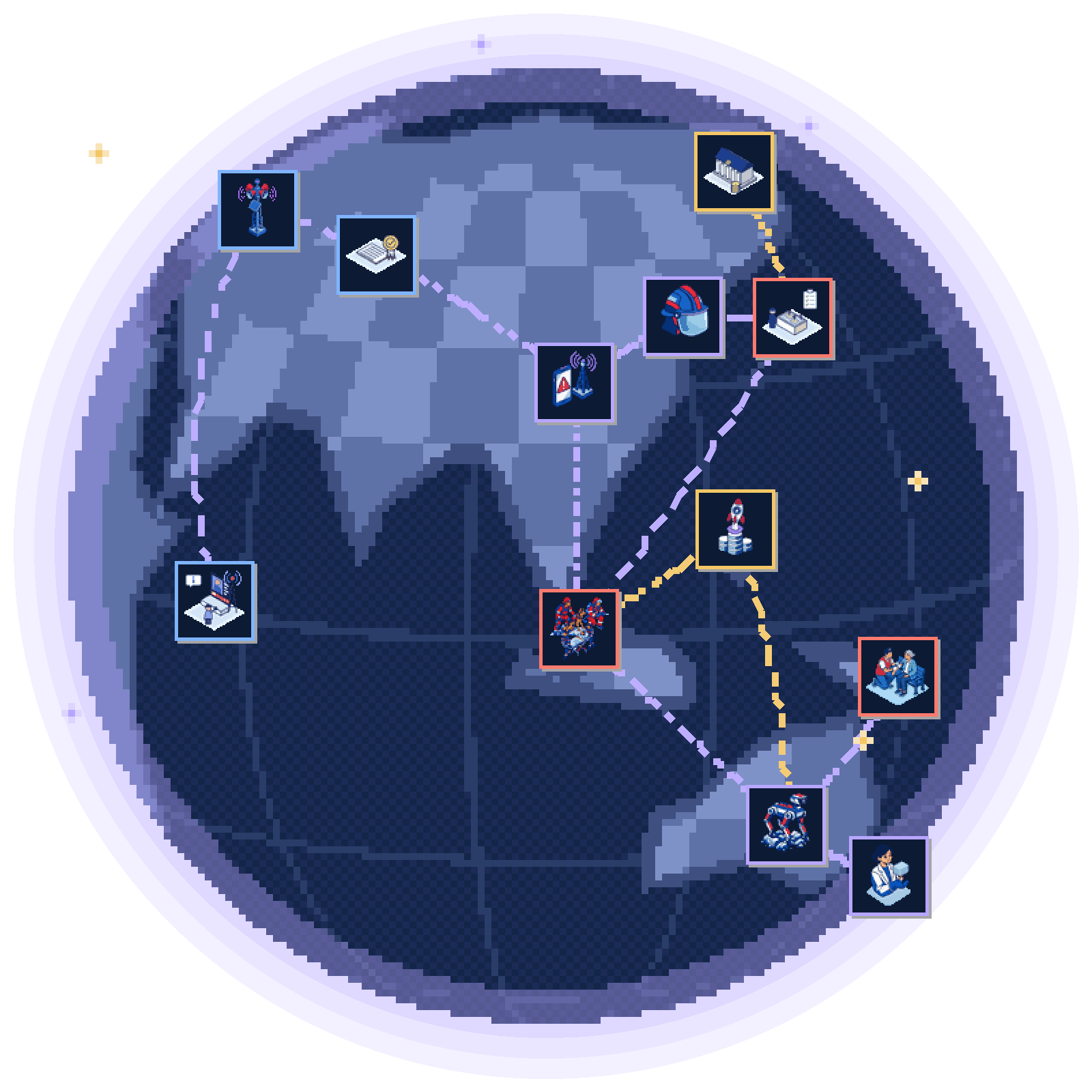 THEME 01
 THEME 02
 THEME 03
 THEME 04
 THEME 05
 THEME 06
 THEME 07
 THEME 08
 THEME 09THEME 01
Map the whole incident before sending anyone in.
Commanders need to know the size, edges and insides of an incident before committing people. Most of that picture is still built by eye and by radio. Drones, satellites and bystander footage could show far more, but every feed lands on its own screen.
Regulators are moving towards routine beyond-line-of-sight drone flights, and 3D scene capture is fast enough to use during an incident. A collective could define a common scene model that every drone, camera and mapping team feeds into, settle airspace and privacy rules with regulators, and build digital twins for rehearsal mid-incident.
 Frontline emergency responders
 Emergency managers & planners
 Vehicle & equipment producers
 Communications & digital infrastructure
 Policy makers and regulators
 Science & research community
 Start-ups, entrepreneurs and innovators
 Standards developersTHEME 02
Cut the water, fuel, foam and emissions that response burns through, without slowing it down.
Emergency services use a lot of fuel, water and chemicals. Some foams leave contamination that outlasts the fire. As climate change brings more wildfires and floods, agencies must do more while shrinking their own footprint, often with no agreed way to measure it.
Agencies are electrifying fleets, adopting compressed-air foam and replacing fluorinated foams. A collective could set a common way to account for the environmental cost and benefit of response, test low-impact equipment in realistic conditions, and show funders that sustainability and speed are compatible.
Frontline emergency respondersVehicle & equipment producersPolicy makers and regulatorsStandards developersScience & research community Innovation, R&D and trade agencies
 Banks, institutional & private capitalStart-ups, entrepreneurs and innovators
 Public emergency response funding bodiesTHEME 03
Keep responders, agencies and the public talking when networks are down, jammed or missing.
Responders still lose contact in basements, tunnels, ships and flooded towns, and crews from different places still can’t always talk to each other. Moving to broadband promises video and data, but ties emergency services to commercial networks that fail in the same disasters.
Satellite messaging is reaching ordinary phones and several countries are migrating national radio networks to broadband. A collective could set the resilience requirements that operators and vendors build to, test interworking across borders and agencies, and plan for the loss of a network rather than hope it will not happen.
Communications & digital infrastructureFrontline emergency respondersPolicy makers and regulatorsVehicle & equipment producers System integrators & solution developersPublic emergency response funding bodiesTHEME 04
Know where every responder is indoors, and find people trapped behind walls or under rubble.
Satellite positioning stops at the door. Inside a burning building or collapsed structure, a commander often can’t say where each firefighter is, and a rescue team can’t say whether anyone is alive under the rubble. Ports and ships now face jammed positioning too.
Positioning techniques are maturing in consumer devices, and building information models could anchor indoor positioning if they were shared with responders. A collective could agree how buildings expose their layouts, how positioning data reaches incident command, and how tracking is tested and certified so crews trust it under stress.
—
Frontline emergency respondersVehicle & equipment producersScience & research communityCommunications & digital infrastructureEmergency managers & planners Public & community respondersStart-ups, entrepreneurs and innovatorsStandards developersTHEME 05
Turn sensors, cameras, calls and social media into decisions a commander can trust.
Incident command gets more data than anyone can read: sensor feeds, video, calls in several languages, social media, partner reports. Most of it never reaches a decision. AI can now summarise, transcribe and fuse it, so the question shifts to trust, governance and where the data is allowed to live.
Large language and vision models make much of this feasible; the questions are now trust, governance and where data may live, and some jurisdictions class emergency-call AI as high-risk. A collective could define what explainability means at an incident, build shared evaluation datasets, and settle how on-premise and edge deployment meet operational and legal requirements.
Policy makers and regulatorsFrontline emergency respondersEmergency managers & plannersCommunications & digital infrastructureSystem integrators & solution developersScience & research communityStart-ups, entrepreneurs and innovatorsTHEME 06Send robots, drones and supervised vehicles where no human should go.
Some tasks shouldn’t be done by a person at all: entering a building that may collapse, approaching a burning vehicle with unknown cargo, surveying a flooded chemical plant. Robots and remotely supervised machines can take them, but most fleets are built for drivers and most robots for factories.
Legged robots, supervised-autonomy kits and unmanned firefighting vessels are in trials, but independent field evidence is thin and liability unclear. A collective could set the operational tests a robot must pass before it joins a crew, work with regulators and insurers on supervised autonomy, and share lessons between agencies.
Frontline emergency respondersVehicle & equipment producersScience & research communityPolicy makers and regulatorsStart-ups, entrepreneurs and innovatorsCommunications & digital infrastructureStandards developersTHEME 07Get responders, supplies and care to people cut off by distance or disaster.
When roads are gone and the nearest hospital is hours away, the emergency is a logistics problem as much as a medical one. Islands, mountains and conflict zones live with this; big disasters bring it to everyone else. Humanitarian and emergency teams still often work side by side rather than together.
New aerial platforms, medical drones, remote health monitoring and treatments that need no cold chain are changing what is possible, and anticipatory finance is growing. A collective could link that finance, these platforms and local responder networks into one plan for each isolated community.
Frontline emergency respondersVehicle & equipment producersPolicy makers and regulatorsEmergency managers & plannersPublic & community respondersCommunications & digital infrastructure Philanthropy & impactInnovation, R&D and trade agenciesStandards developersPublic emergency response funding bodiesTHEME 08
Keep responders safe from heat, toxins, injury and the slow harm of stress.
The people who respond carry the risk long after the incident. Firefighting was classed as carcinogenic in 2022, heat stress is rising, protective gear is being rebuilt without PFAS, and burnout and PTSD are widespread. Stigma still stops many from asking for help.
Wearable monitoring, cooling garments and early distress signals are now realistic, and jurisdictions are legislating on protective gear. The harder questions are about data: who sees a responder’s physiological or stress data, and what happens to it. A collective of unions, employers, psychologists, manufacturers and regulators could set those rules.
Frontline emergency respondersStandards developersVehicle & equipment producersPolicy makers and regulatorsScience & research communityStart-ups, entrepreneurs and innovatorsPublic emergency response funding bodiesTHEME 09Practise the rare, dangerous, many-agency scenarios often, together, and without the risk.
The incidents that matter most are rare, and no agency can practise them enough alone. Live exercises are costly, hard to schedule and limited in what can safely be staged. New skills like teleoperation and AI support have to be learned somewhere first.
Consumer headsets have cut the cost of immersive training, and digital twins and realistic avatars make multi-agency rehearsal possible remotely. A collective could build shared scenario libraries, agree how simulated hours count towards accreditation, and use training records to find skills gaps early.
Frontline emergency respondersStandards developersCommunications & digital infrastructureScience & research communityPublic & community respondersEmergency managers & plannersStart-ups, entrepreneurs and innovatorsPublic emergency response funding bodies






Where tomorrow’s lifesaving tech takes the stage.
A festival where start-ups, hackathon teams and researchers put new technology to work on real emergency-response challenges.
The meeting point of every TLC platform.
Frontline Innovation, Research, Science & Technology
A year-long journey for the frontline’s boldest innovators.
A year-long programme for operators who champion innovation in their own organisations: the know-how and the network to bring new ideas into daily practice.
Fellows bring frontline insight to FIRST Horizon and FIRST Beacon, and meet the ecosystem at Fast Forward.
Frontline Innovation, Research, Science & Technology
See the future of the frontline before it arrives.
A bespoke scouting service that maps what’s next for one corner of emergency response, say, the future of call centres.
Findings feed into Fast Forward, and can become open challenges through FIRST Beacon.
Frontline Innovation, Research, Science & Technology
Call the world’s solvers to the challenges that matter.
The next step after FIRST Horizon: innovation challenges published to open the search for solutions, globally or in one market.
Builds on FIRST Horizon’s findings and brings its finalists to the stage at Fast Forward.
Step through to the futures of lifesaving.
Future-scenario labs and thought experiments that help the sector imagine, stress-test and prepare for the futures it could face.
Portals opens the big questions; FIRST Horizon maps the specifics; the boldest ideas head to Fast Forward.
Lifesaving Innovation, Science & Technology, and Entrepreneurship Development
Where lifesaving ideas are forged into ventures.
An incubator that turns ideas from hackathons, research and prototypes into businesses that can serve the frontline.
Takes the best ideas from Fast Forward, FIRST Beacon and Portals and readies them for investment and first customers.